
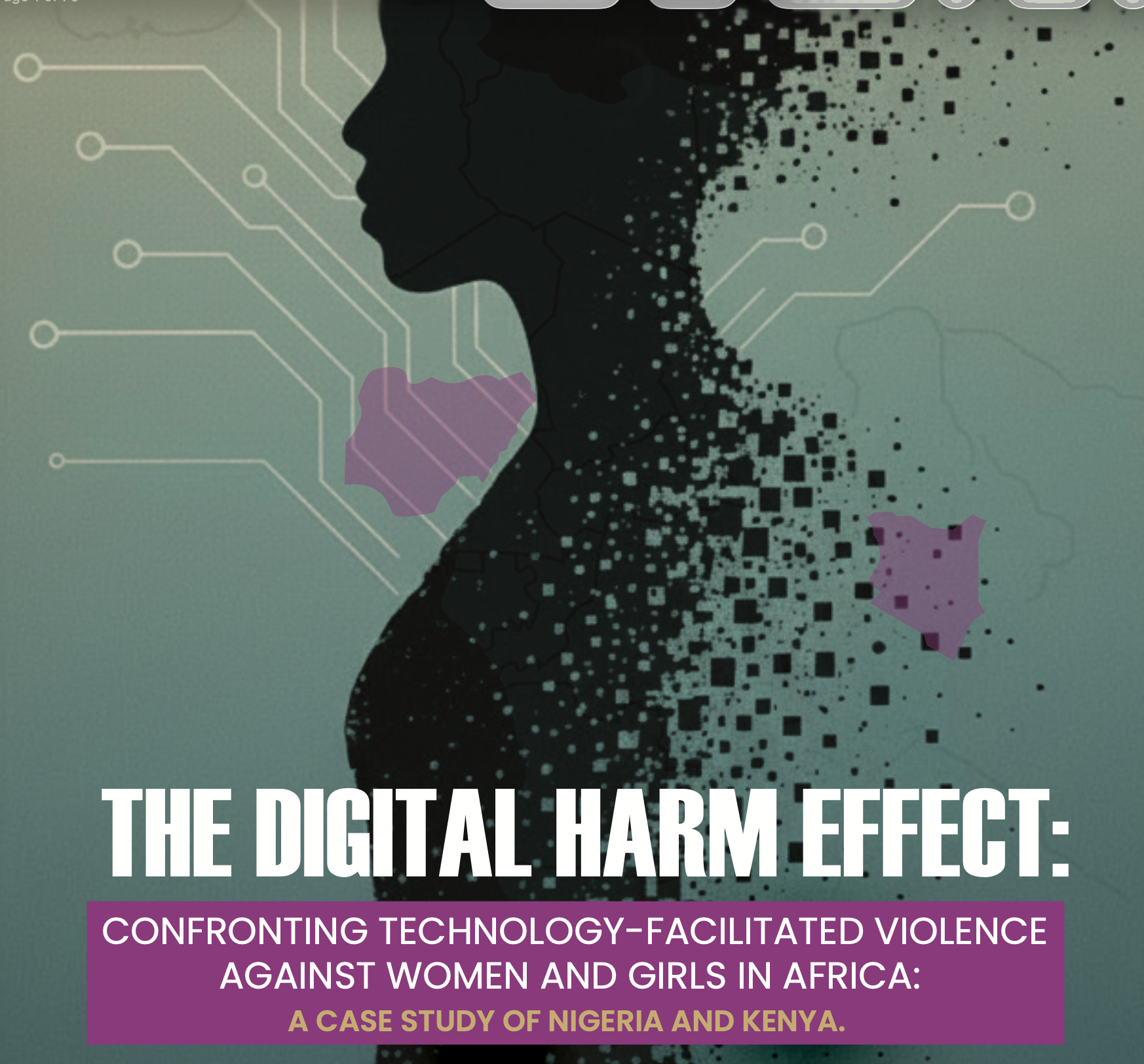
The Digital Harm Effect: CONFRONTING TECHNOLOGY-FACILITATED VIOLENCE AGAINST WOMEN AND GIRLS IN AFRICA:
THE DIGITAL HARM EFFECT:
CONFRONTING TECHNOLOGY-FACILITATED VIOLENCE AGAINST WOMEN AND GIRLS IN AFRICA:
A CASE STUDY OF NIGERIA AND KENYA.
Click here to Download the full report: “The Digital Harm Effect: Confronting Technology-Facilitated Violence Against Women and Girls in Africa:A Case Study of Nigeria and Kenya” to explore detailed findings, survivor testimonies, and comprehensive recommendations for building safer digital futures.
Technology-Facilitated Violence Against Women: Africa Digital Harm Report
Technology has transformed from a tool of empowerment into a weapon of control for women and girls across Africa. A groundbreaking comparative study of Nigeria and Kenya reveals how digital platforms have created new battlegrounds where women face harassment, exploitation, and silencing—not despite being online, but precisely because they are.
The Paradox of Digital Connectivity: Technology-Facilitated Violence
In both Nigeria and Kenya, nearly every woman surveyed had experienced some form of technology-facilitated violence, from psychological harassment and surveillance to sexual exploitation and economic control. The ubiquity of smartphones has expanded opportunities while simultaneously expanding terrain for abuse, with perpetrators exploiting anonymity, weak legislation, and indifferent justice systems.
How Technology-Facilitated Violence Against Women Manifests
Digital Violence in Nigeria: WhatsApp Harassment and Online Abuse
In Nigeria, violence spreads through group WhatsApp harassment and non-consensual sharing of naked pictures, creating a culture predicated on anonymity and silence. Digital illiteracy, loopholes in cyber legislation, and unwillingness by justice systems to treat online abuse as “real violence” leave survivors vulnerable to predation. Young women, activists, and journalists face the greatest risk, with abusers exploiting weak legislation and entrenched cultures of stigma and victim-blaming.
The study surveyed 223 respondents across Nigeria’s 36 states, revealing that violence cuts across regions, socio-economic classes, and age cohorts. Beyond the documented cases lies a more disturbing reality: rural women, those without smartphones, and survivors too afraid to name their abusers remain invisible in the data.
Technology-Facilitated Violence in Kenya: Legal Gaps Despite Progressive Laws
Kenya presents a paradox of regulation without protection. While the Computer Misuse and Cybercrimes Act (2018) exists, its gender-neutral provisions erase the specificity of technology-facilitated violence against women and girls. The country’s 292-respondent online survey showed similar patterns: hyperconnectivity introduces both visibility and danger.
Survivors confront everyday challenges including poor implementation, suspicion toward authorities, stigmatization, and minimal survivor-centered support. Silence becomes the result—enforced silence that empowers perpetrators and reinforces cycles of online abuse.
Systemic Failures Enabling Digital Violence Against Women
What both countries share transcends mere prevalence of abuse. Systemic failures make violence possible: laws written with no consideration for women, institutions that neglect duties or refuse to enforce protections, cultures that shame survivors for harm done to them, and a virtual economy where technology companies profit from women’s participation without investing in their safety.
Social Media Platforms and Technology-Facilitated Abuse
Facebook, WhatsApp, Instagram, TikTok, and Twitter serve as primary spaces of engagement where women and girls face daily harassment through private messages, group spaces, or public shaming. The study highlights how non-consensual image sharing, cyberstalking, and digital harassment become everyday realities, with much of the response framework broken.
Justice System Failures in Addressing Online Violence Against Women
Survivors confront stigma, distrust in law enforcement, and a justice system out of sync with how quickly technology advances. Youth aged 15–25 bear the brunt of exposure yet remain without adequate protection or targeted interventions. Police lack digital forensics skills, prosecutors remain unfamiliar with online abuse, and courts are ill-equipped to handle cases of technology-facilitated harm.
Feminist Movements Fighting Technology-Facilitated Violence
Despite overwhelming odds, feminist movements in both countries—most young, tech-savvy, and online-led—are pushing back, mobilizing solidarity, and demanding accountability. Organizations like Womanifesto, AREWA MeToo, FIDA Kenya, and CREAW serve as first responders, doing work the state should do but does not.
However, their activism remains scattered and under-resourced, confronting the scale of the problem without collective support from state institutions or sufficient donor funding.
A Path Forward: Survivor-Centered Solutions” → “Addressing TFGBV: Survivor-Centered Solutions for Digital Violence
The research identifies urgent interventions needed to build safe and inclusive digital futures:
Legal and Policy Reform
Both countries must update and strengthen legal frameworks to clearly define and criminalise the full spectrum of TFVAWG, aligning with regional and international standards. Law enforcement and judicial actors need continuous training on trauma-informed and survivor-centered responses, supported by standard procedures for digital evidence and dedicated TFVAWG units.
Institutional Accountability
Survivors require safe, accessible reporting channels and holistic support systems delivered in partnership with feminist organizations. Public awareness, digital literacy, and community education—especially among young people—are essential to shift harmful norms, reduce stigma, and normalize reporting.
Multi-Stakeholder Collaboration
Strengthening intergenerational feminist leadership, investing in youth programming, and ensuring meaningful inclusion of women and girls with disabilities will deepen impact and ensure no one is left behind. Multi-stakeholder collaboration between government, civil society, tech companies, and feminist networks is crucial for prevention, accountability, and safer digital platforms.
Funding and Data Infrastructure
Sustained funding and improved data systems are urgently needed to support long-term prevention and response efforts, enable evidence-based action, and build coordinated national and regional architecture for addressing TFVAWG.
Technology-Facilitated Violence Prevention: From Harm to Liberation
The report serves as both evidence and manifesto. Technology is not neutral—it is built in manners that reflect offline inequalities online. Unless women’s safety is placed at the center of digital governance, the promise of technology as a tool for liberation will remain out of reach, an open door leading not to empowerment but to yet another arena of violence.
The task ahead is urgent and unambiguous: Africa must move beyond token reforms to survivor-centered, gender-sensitive, and intersectional strategies that dismantle impunity, strengthen justice systems, and hold both states and tech platforms accountable. The digital space cannot remain another frontier of violence; it must become a ground of liberation.
Download the full report: “The Digital Harm Effect: Confronting Technology-Facilitated Violence Against Women and Girls in Africa: A Case Study of Nigeria and Kenya” to explore detailed findings, survivor testimonies, and comprehensive recommendations for building safer digital futures.